
GridLeaf
energy system
The modular wind and solar generation unit.
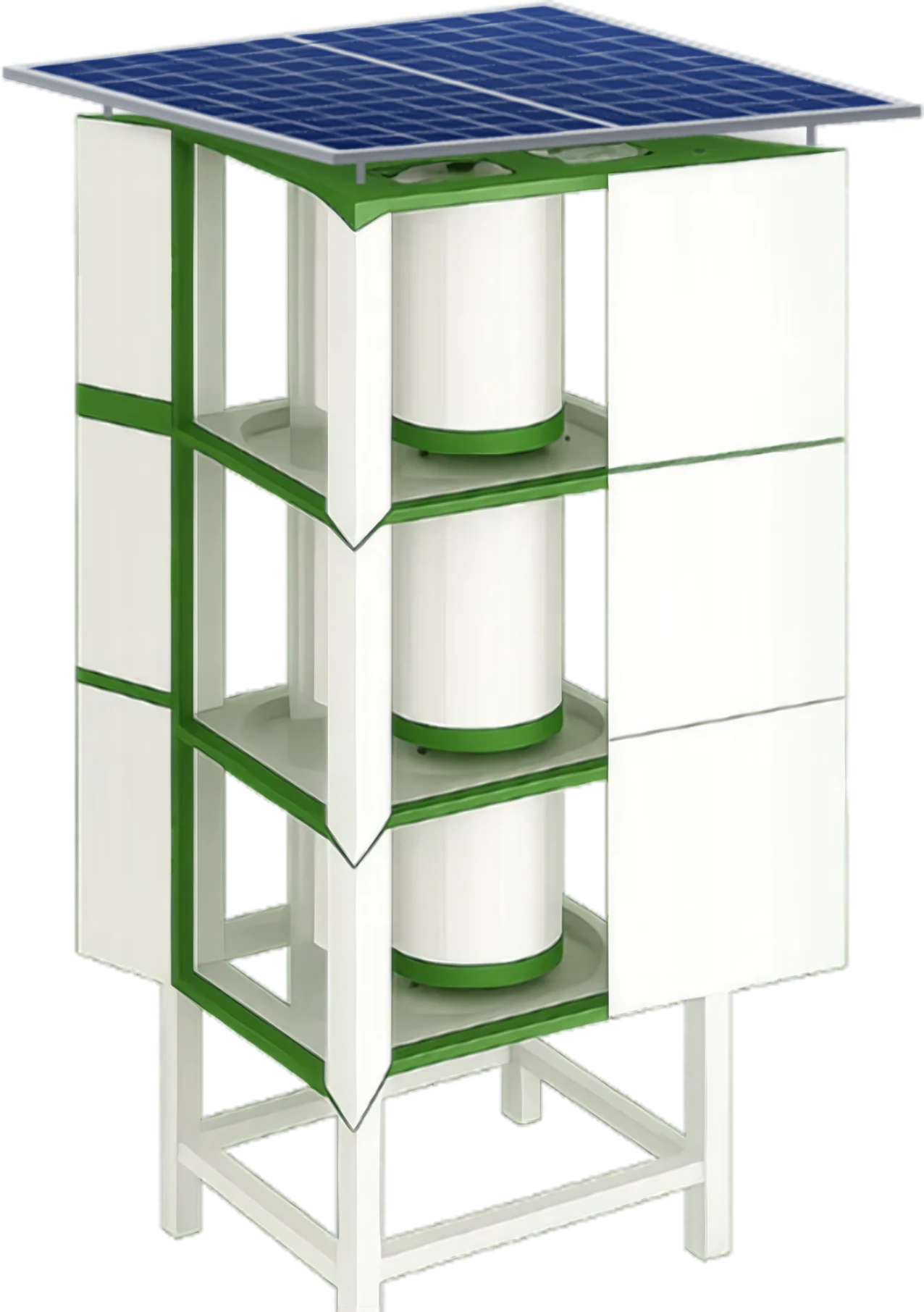
450 W of wind and 240 W of solar on a 2 ft × 2 ft footprint. Three stacked rotors inside WindBoost panels pull power from wind out of any direction.
At a glance
Power curve
What the turbine produces at each wind speed. It starts at 4.7 mph, reaches rated output near 30 mph, and cuts out above 40 mph.
Full specifications
Wind turbine
- Rated power
- 450 W
- Rated wind speed
- 29.7 mph13.3 m/s
- Rated rotor speed
- 550 rpm
- Cut-in / cut-out
- 4.7 / 40 mph2.1 / 17.9 m/s
- Blade height
- 5.78 ft1.76 m
- Blade diameter
- 1.88 ft0.57 m
- Swept area
- 10.84 ft²1.01 m²
- Rotor
- Savonius, 3 stacked moduleswith WindBoost
- Generator
- Axial flux, coreless
- Frame
- Bolted aluminumno welds
- Noise
- < 40 dBambient operation
Solar canopy
- Rated power
- 240 W2 × 120 W panels
Per panel:
- Max power voltage (Vmp)
- 28.89 V
- Max power current (Imp)
- 4.21 A
- Open-circuit voltage (Voc)
- 33.69 V
- Short-circuit current (Isc)
- 4.67 A
Size and weight
- Footprint
- 2 × 2 ft0.61 × 0.61 m
- Unit weight
- 218 lb99 kg
- Per module
- ~55 lb~25 kg
Values may change as the design is iterated and certified. Download the datasheet (PDF).
Mounting
One unit, many ways to deploy seamlessly. The bolted frame mates with a base, a wall, or a roof without changing the machine.
Ground
A flexible base that interfaces with open ground or a pad.
Wall
Brackets to a building face to catch the wind that runs along it.
Roof
Anchors to flat or pitched roofs, where the wind is cleanest.
Check your site
A quick read on your region using public climate data. It isn’t nearly as rigorous as our internal site assessment, but it will tell you whether your area is worth a closer look.
Local exposure changes things a lot: elevation relative to the land around you, open water nearby, trees, and buildings can all push a site well above or below this estimate.
Estimated savings per year vs.
- Diesel generator—
- Solar + battery—
- Grid extension—
At this exposure, a site assessment will show whether GridLeaf beats your current option.
How the options compare
Cost is only part of it. Here’s how each way of powering an off-grid load stacks up on everything else that matters at the site.
generatorGrid
extensionSolar +
batteryGridLeaf
+ battery
Gen 2 pilots are open now.
Tell us about your site and what you need to power. We’ll run the numbers and tell you straight whether GridLeaf is the right fit.